
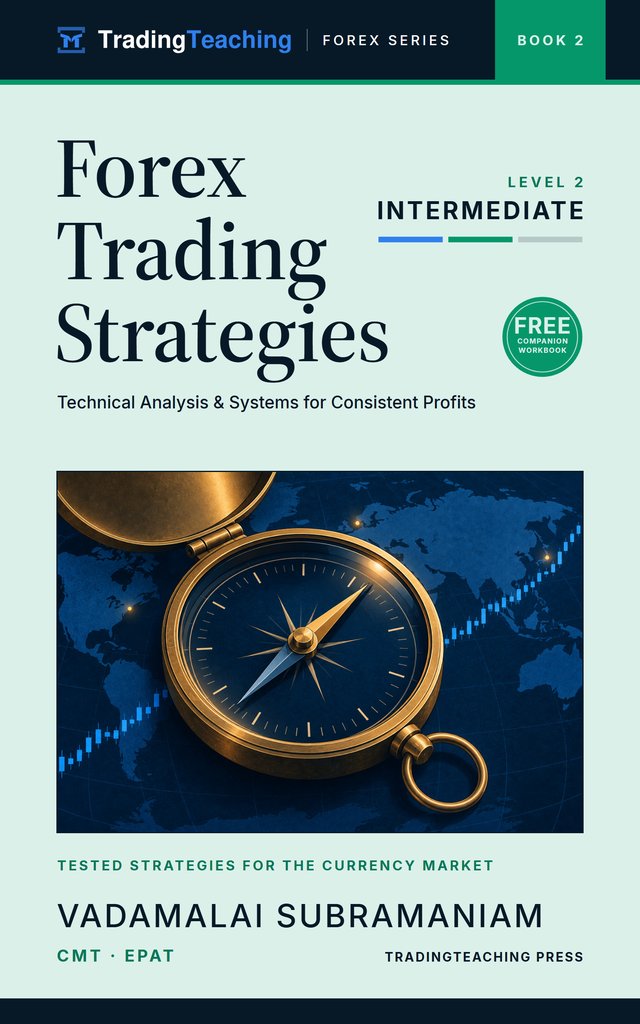
2027 EditionForex Series · Book 2 of 3
Forex Trading Strategies
Technical Analysis & Systems for Consistent Profits
The second book moves from mechanics to method. It starts with the psychology that decides whether a plan gets followed, then works through candlesticks in context, trend analysis, Fibonacci, Bollinger Bands, momentum oscillators and multiple timeframe analysis, before day and swing trading setups, position sizing, and building, testing and journaling a trading system. Where the field makes a claim, the book checks it against ten years of market data.
Buy on Amazon.com
Kindle eBookKindle editions arrive instantly$12.99 PaperbackPaperbacks ship to the UAE$29.99- Paperback ISBN9798199698177
- PublisherTradingTeaching Press
- Read firstBook 1: Foundations
This is education only, not financial advice. Trading is high-risk. Check local laws, your residency rules and your finances. Readers in the UAE: order from Amazon.com.
- 12 Chapters, Psychology to Systems
- Common Claims Tested Against Data
- Day and Swing Trading Setups
- Free Companion Workbook
- A Quiz for Every Chapter, with Answers
- Building and Testing a System
Inside Forex Trading Strategies
Six of the twelve chapters, in the book's own words.
The Trader's Mindset: Psychology of Winning
You have probably also discovered that knowing what to do and doing it are two different things. (Chapter 1)
Trend Analysis
Reading market structure is the one skill on which every other part of this book depends. Structure tells you who is in control, buyers or sellers, and whether that control is strengthening or weakening. (Chapter 3)
Fibonacci Trading Techniques
Before you can apply it well, you need to know where the numbers come from, what they are claimed to do, and what they actually do when someone counts. (Chapter 4)
Multiple Timeframe Analysis
This chapter sets out the method: how to choose a set of timeframes, how to use the higher ones for direction, context and targets and the lower ones for precise entries, and how to avoid the mistakes that trap single-timeframe traders. (Chapter 7)
Position Sizing and Risk Control
This chapter covers the arithmetic of position sizing, how to measure the risk on a trade precisely, and the methods that control the exposure of a whole portfolio, so that you can protect your capital and still capture meaningful profits. (Chapter 10)
Building and Testing Trading Systems
A trading system is more than a collection of indicators and rules. It is a framework that tells you what to do in every situation: when to trade and when to wait, where to enter and where to exit, how much to risk, and how to manage the trade from start to finish. (Chapter 11)
Complete chapter overview
The twelve chapters of the 2027 Edition.
The Trader's Mindset: Psychology of Winning
You have probably also discovered that knowing what to do and doing it are two different things.
Why Execution Matters More Than Strategy · Fear and Greed · Emotional Intelligence for Trading · The Winning Trader's Beliefs · Handling Losses · Handling Wins · Building Mental Discipline · Managing Trading Stress · The Growth Mindset · Creating Your Psychological Edge
Advanced Candlestick Patterns
A hammer in the wrong place means nothing, and an engulfing pattern against a strong trend often fails. The advanced candlestick trader treats context as the deciding factor, and most of this chapter is about context.
Why Basic Pattern Trading Fails · What the Patterns Are Worth · Four Context Filters · Single-Candle Patterns · Two-Candle Patterns · Three-Candle Patterns · Patterns of Four Candles or More · Confluence · Trading the Failed Pattern · A Trading Plan for Patterns · Training Your Eye · What the Measurements Add Up To
Trend Analysis
Reading market structure is the one skill on which every other part of this book depends. Structure tells you who is in control, buyers or sellers, and whether that control is strengthening or weakening.
Market Structure · Identifying the Trend · Trendlines · Channels · The Four Phases of a Market Cycle · Continuation Patterns · Reversal Signals · Pullback Trading · A Trend Trading System · What the Chart Patterns Are Worth
Fibonacci Trading Techniques
Before you can apply it well, you need to know where the numbers come from, what they are claimed to do, and what they actually do when someone counts.
The Mathematics Behind Fibonacci · Does Fibonacci Work in Markets? · Fibonacci Retracements · Key Retracement Levels · The Golden Zone · Fibonacci Extensions · Fibonacci Trading Strategies · Fibonacci Confluence · Fibonacci and Multiple Timeframes · Common Fibonacci Mistakes · Managing a Fibonacci Trade
Bollinger Bands
This chapter covers the bands themselves, what they do and do not predict, three basic strategies, two derived indicators, and the Double Bollinger Band system, which turns the bands into a way of classifying the trend and deciding whether to trade at all.
How the Bands Are Built · Reading the Bands · Three Basic Strategies · Two Derived Indicators · Double Bollinger Bands · DBB Entries and Exits · Managing a DBB Trade · Combining the Bands with Other Indicators · The Complete DBB System
Momentum and Oscillator Strategies
The chapter covers the three most widely used momentum tools, MACD, the Stochastic and RSI, then how to combine them.
Understanding Momentum · MACD · MACD Trading Signals · Divergence · The Stochastic Oscillator · Stochastic Trading Strategies · RSI: Advanced Applications · Combining Momentum Indicators · A Complete Momentum System · Momentum Across Timeframes · Common Momentum Mistakes
Multiple Timeframe Analysis
This chapter sets out the method: how to choose a set of timeframes, how to use the higher ones for direction, context and targets and the lower ones for precise entries, and how to avoid the mistakes that trap single-timeframe traders.
Why More Than One Timeframe · The Timeframe Hierarchy · Top-Down Analysis · Timeframe Alignment · Support and Resistance Across Timeframes · Trend Across Timeframes · Indicators Across Timeframes · Entry Techniques · Managing the Trade · Two Complete Systems
Day Trading Setups and Execution
This chapter sets out those setups, the hours in which to trade them, a complete system for intraday opportunities, and the discipline and risk management without which the account does not survive long enough for the setups to matter.
What Day Trading Demands · When to Trade · Timeframes and the Pre-Market Routine · Four Core Setups · Three Session Strategies · Entries · Exits · Risk Management · Psychology · The Complete System · Trading Around News Events · From Demo to Live
Swing Trading Strategies
This chapter covers the setups that work for swing trading, how to time entries with more than one timeframe, how to manage trades that last days to weeks, and the patience the style asks of you above all else.
What Swing Trading Is · What It Asks of You · Three Timeframes · Four Core Setups · Patterns, Channels and Moving Averages · Entering the Trade · Managing the Trade · Risk on a Swing Trade · The Psychology of Waiting · A Complete Swing Trading System · Five Common Mistakes · From Study to Live Trading
Position Sizing and Risk Control
This chapter covers the arithmetic of position sizing, how to measure the risk on a trade precisely, and the methods that control the exposure of a whole portfolio, so that you can protect your capital and still capture meaningful profits.
The Foundation of Risk Management · Position Sizing Fundamentals · How Much to Risk on Each Trade · Stop Loss Strategies · Advanced Position Sizing Methods · Portfolio Risk Management · Drawdown Management · Risk and Reward · Money Management Systems · Tracking Your Risk · Advanced Risk Concepts · Putting It Together
Building and Testing Trading Systems
A trading system is more than a collection of indicators and rules. It is a framework that tells you what to do in every situation: when to trade and when to wait, where to enter and where to exit, how much to risk, and how to manage the trade from start to finish.
What a Trading System Is · Designing the System · Writing the Rules · Backtesting · Reading the Results · Avoiding Backtesting Pitfalls · Forward Testing on Demo · Optimizing the System · Testing for Robustness · Documenting the System · Living with the System · From Design to Live Trading
The Trading Journal
This chapter shows how to build a journal, keep it up, and use it, so that in time you can coach yourself.
Why Keep a Journal · What to Record · Grading the Trade · Analyzing the Journal · What a Subgroup Can and Cannot Tell You · The Review Routine · Turning Data into Improvement · Tools for the Journal · Building the Habit · Common Journaling Mistakes
Prefer to watch?
The Forex Trading Strategies video course teaches this book lesson by lesson on the TradingTeaching Academy. The whole of Book 2: trend analysis, Fibonacci, Bollinger Bands, oscillators, multiple timeframes, day and swing setups, and building and testing a trading system.
- 96 lessons
- 12 modules
Course 2Forex Trading Strategies

Vadamalai Subramaniam, CMT, EPAT
Vadamalai Subramaniam is a Chartered Market Technician (CMT) and completed QuantInsti's Executive Programme in Algorithmic Trading (EPAT). He brings 15+ years of professional market knowledge to the Forex Series.
More about the authorThree books, read in order
-
 Book 1 · Beginner
Forex Trading Foundations
An introduction to the currency market: how it works, currency pairs and order types, choosing a broker, reading a chart, first indicators and risk management.
-
Book 2 · IntermediateThis book
Forex Trading Strategies
Trend analysis, Fibonacci, Bollinger Bands, momentum and multiple-timeframe setups, with position sizing, system testing and a trading journal.
-
 Book 3 · Advanced
Forex Trading Mastery
Institutional Methods & Smart Money Concepts: order flow, harmonic patterns, volatility, correlation, multi-pair portfolios and trading as a business.
Continue the Forex Series
Forex Trading Strategies on Amazon: Kindle $12.99, paperback $29.99.
This is education only, not financial advice. Trading is high-risk. Check local laws, your residency rules and your finances.
Readers in the UAE: order from Amazon.com. Kindle editions arrive instantly and paperbacks ship to the UAE.